
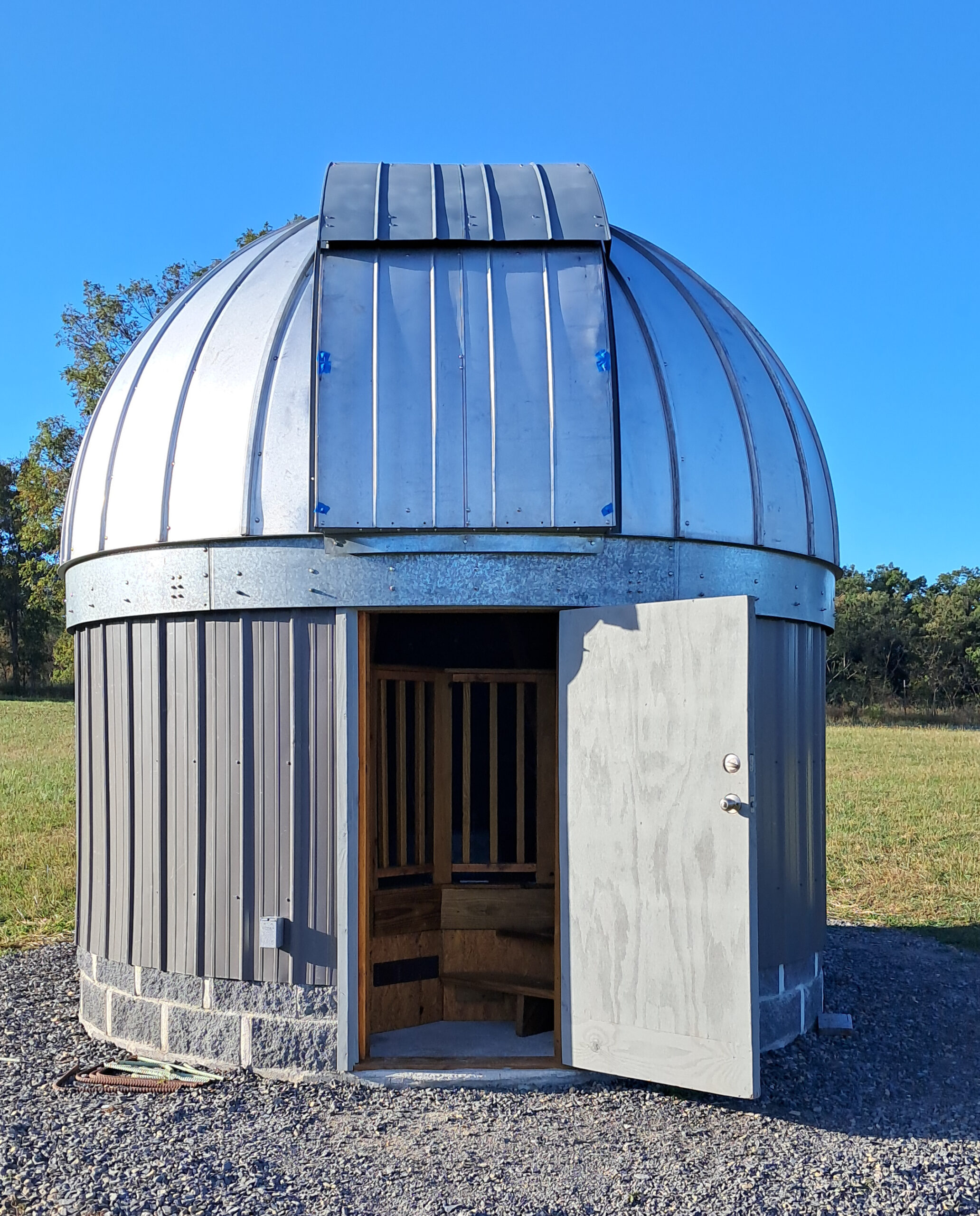
The observatory is located in a quiet, rural area of the Potomac Highlands of West Virginia. We are at an elevation of around 1120-feet in a wide valley encompassed by long ridges of 2000 feet elevation.
The Galvalume dome is twelve-and-a-half feet in diameter and mounted atop a round building with an elevated interior floor. Another larger building, about 300 feet from the dome, serves as a “warm room” and office, with both buildings interconnected via a local area network.
The goal is to automate most functions of the observatory so it can be remotely operated, but achieving 100% remote control is not an absolute necessity since I live onsite. The main purpose of automation is to be able to control the telescopes and cameras from a classroom environment.
The main instruments the dome will house are a modified Celestron C-11 XLT 11-inch f/10 Schmidt-Cassegrain telescope, and an Astro-Tech 6-inch f/9 Ritchey-Chretion Astrograph for deep sky imaging mounted on a HDX-110 (Skywatcher EQ-8) heavy duty equatorial mount.
Other instruments available as needed include a Vixen ED80sf (for planetary or Lunar imaging), an Orion ST-80 for autoguiding, and a Coronado PST solar telescope for live views of the sun.
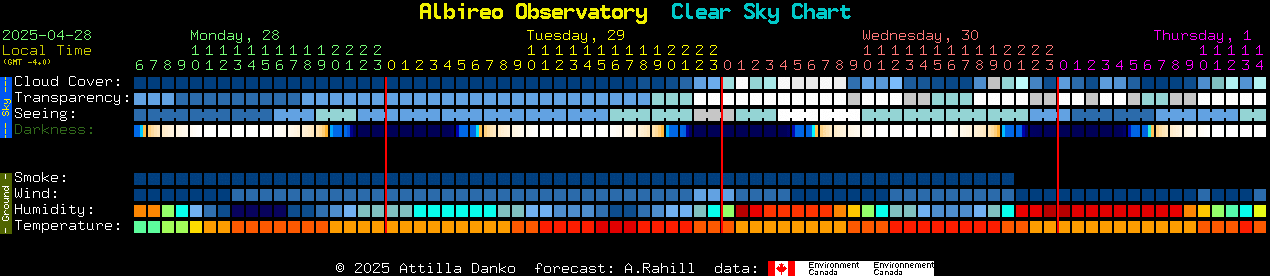
Click on the chart for more details of weather and viewing conditions.
Page last edited 10/10/2026